Best Of
Best Voice AI for Outbound Sales Calls: 2026 Guide
Use this updated 2026 guide to evaluate the best voice ai for outbound sales calls 2025 shortlist for compliance, CRM integration, scale, and payments.
 Awais AhmadJul 12, 2026
 Zeeshan AhmadJul 12, 2026
Outbound automation fails when teams automate activity before they define who should be contacted, what counts as a response, and when a human should take over. Effective B2B outbound sales automation strategies connect targeting, messaging, calling, scheduling, CRM updates, and suppression rules into one controlled process. In 2024, Salesforce reported that sales representatives spent only 28% of their week actually selling, leaving 72% for administration and other work (Salesforce, Top Sales Trends for 2024). The seven strategies below were selected for three reasons: they remove repeatable manual work, preserve rep judgment at high-value moments, and produce measurable pipeline outcomes rather than inflated activity counts.
The best programs automate state changes, not judgment. In 2025, HubSpot found that social produced the highest cold-outreach response rate for 42% of sellers, versus 26% for email and 23% for phone (HubSpot, State of Sales Report). Match channels to buyers, protect sending infrastructure, and measure meetings and revenue.
A narrow ideal customer profile gives every later automation a reliable eligibility decision. In 2025, HubSpot reported that 68% of surveyed sales teams saw lead quality improve year over year, reinforcing why list quality deserves more attention than raw volume (HubSpot, State of Sales Report). Store firmographic filters, territory, role, buying trigger, account owner, consent state, active opportunity status, and last-contact timestamp as structured fields.
The best practices for automating outbound sales outreach begin with exclusions: current customers, open deals, unsubscribed contacts, bounced addresses, recently contacted accounts, and records missing a verified endpoint. Run those checks before sequence enrollment, then repeat them before every call or message because CRM state changes after enrollment. We have seen more damage from stale suppression logic than from weak copy because duplicate outreach makes the entire system look careless.
Event-driven sequences keep each contact moving from one known state to the next instead of relying on disconnected timers. In 2025, HubSpot found that social, email, and phone produced materially different cold-outreach response patterns, so a multichannel sequence should react to engagement instead of treating every channel as interchangeable (HubSpot, State of Sales Report). A practical state model might include eligible, email_sent, call_queued, connected, replied, meeting_booked, disqualified, and suppressed.
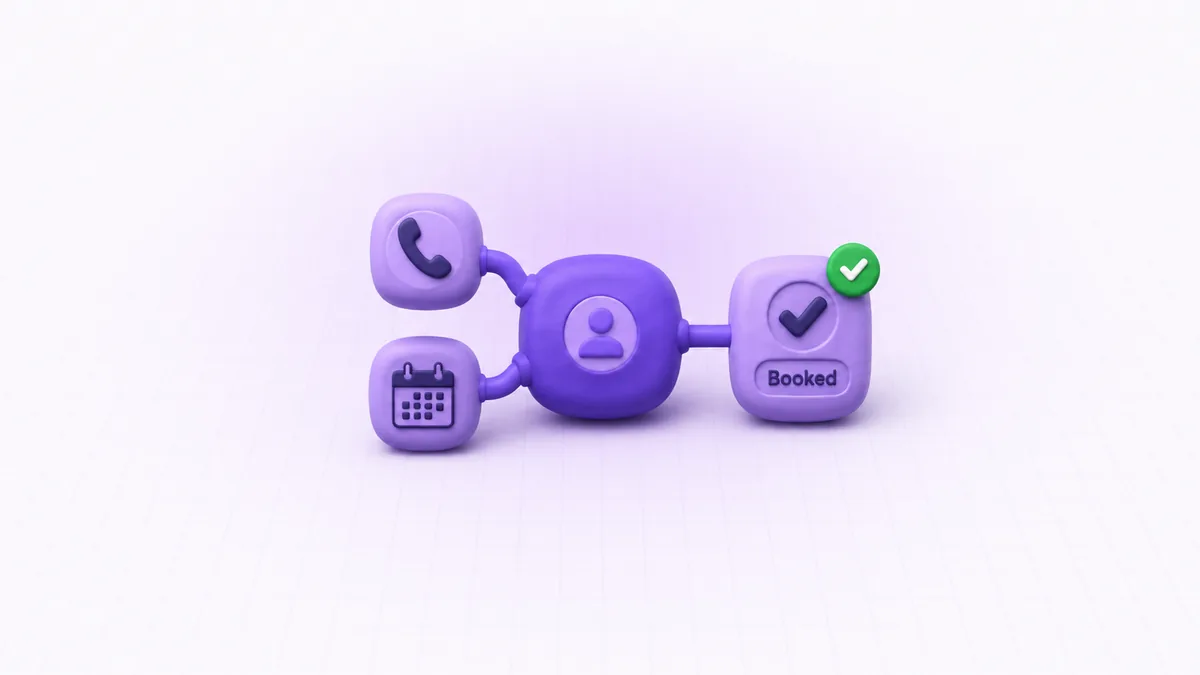
Use HubSpot workflow actions or equivalent CRM automation to update fields, rotate owners, create tasks, and unenroll contacts when a reply or booking arrives. The tools used to automate outbound sales while keeping the process consistent should share one contact identifier and one source of truth. Outbound sales appointment automation handles this layer exactly this way: Twilio callbacks and calendar checks write one authoritative booking state, preventing repeat calls without manual checking.
Automated calling works when the system can distinguish queued, ringing, answered, busy, failed, no-answer, and completed calls. In Twilio's 2026 documentation, the default outbound rate for Programmable Voice is 1 call per second, with calls above the account limit queued at the configured rate (Twilio, Calls per Second). Use the Twilio Voice Call resource to create calls and status callbacks to write terminal outcomes back to the CRM.
The benefits of automated outbound calling for sales teams are faster follow-up, consistent retry rules, and immediate routing to a rep or scheduler when interest is detected. AI can classify intent, answer bounded questions, and collect qualification fields, but it should not invent pricing, eligibility, or contractual claims. Before using artificial or prerecorded voice, validate consent, opt-out, recording, carrier, state, and jurisdiction-specific requirements; the FCC's robocall guidance treats prior consent as a central control.
Useful personalization changes the reason for contact, while weak personalization merely inserts a name or compliments a website. In 2025, 83% of sales professionals surveyed by HubSpot said AI helped personalize prospect interactions, but the underlying data still determines whether the message is credible (HubSpot, State of Sales Report). Build messages from verified fields such as role, industry, relevant product, recent trigger, territory, and one approved pain hypothesis.
A safe pattern is to generate a short opening line from structured evidence, then select the rest of the message from reviewed templates. Reject output when source fields are missing, unsupported, or older than your freshness threshold. When setting up automated outbound sales without sacrificing personalization, preserve a manual-review path for strategic accounts and log the source fields used in every generated message so a rep can explain why the prospect received it.
Email infrastructure must be treated as a capacity system with authentication, reputation, and complaint limits. In 2024, Google defined bulk senders as domains sending about 5,000 messages or more to Gmail accounts in 24 hours and required SPF, DKIM, and DMARC for those senders (Google, Email Sender Guidelines). Configure authentication, domain alignment, one-click unsubscribe where required, bounce handling, and automatic suppression before raising daily send limits.
The impact of outbound sales automation on email deliverability becomes visible when volume rises faster than positive engagement. Monitor the Google Postmaster Tools dashboards for spam rate, IP reputation, domain reputation, authentication, and delivery errors, then reduce volume when indicators deteriorate. Do not rotate domains to hide poor targeting. Fix the list, message relevance, cadence, and opt-out handling first, and follow the FTC's CAN-SPAM compliance guidance for commercial email.
A successful program is measured by qualified conversations, meetings held, opportunities created, and revenue influenced, not by emails sent or calls attempted. In 2025, 42% of HubSpot respondents named annual recurring revenue as their most important sales success metric, while fewer than 5% prioritized pipeline coverage, lead scoring, or sales linearity (HubSpot, State of Sales Report). Activity is diagnostic data, not the final score.
The key metrics to measure the success of an automated outbound sales program are positive-reply rate, connect rate, qualified-meeting rate, show rate, opportunity rate, pipeline per 1,000 eligible contacts, unsubscribe rate, complaint rate, and cost per qualified meeting. Break each metric down by segment, sequence version, channel, rep, and data source. For an underperforming program, audit the funnel in order: eligibility, delivery, contact, response, qualification, booking, attendance, and opportunity creation. That sequence shows where the system is losing value.
A pilot should scale only after its conversion quality, compliance controls, and operational handoffs remain stable across several cohorts. In fiscal year 2025, the FTC received more than 2.6 million Do Not Call complaints and reported over 258 million active registrations, showing why volume increases must preserve suppression and governance controls (FTC, National Do Not Call Registry Data Book 2025). Increase one dimension at a time: list size, daily sends, call concurrency, segments, or rep coverage.
Scaling an automated outbound sales program after a successful pilot also requires queue limits, retry backoff, idempotency keys, owner-capacity checks, and rollback switches. The best tools for outbound sales workflow automation are the ones that expose CRM state, webhook failures, scheduling conflicts, and message outcomes without forcing operators to reconcile separate dashboards. Any outbound sales tools comparison should score CRM integrations and workflow automation against those operational needs, not against the length of the feature list.
The seven strategies work because they keep targeting, execution, and measurement tied to one shared state model. In 2024, Salesforce found that sellers spent 72% of their week outside direct selling activity, which is exactly the administrative surface automation should reduce (Salesforce, Top Sales Trends for 2024).
If the pilot is producing qualified meetings but operators still reconcile call outcomes, bookings, and CRM records by hand, the fastest starting point is a one-hour event-and-field mapping session. Document each trigger, source field, terminal state, and suppression rule before adding volume.
Outbound sales appointment automation uses Twilio callbacks and calendar checks to book leads without duplicate calls.
The practical answers below focus on controlled pilots, measurable state changes, and clear human handoffs. In 2025, the FTC counted over 258 million active Do Not Call registrations, so any calling workflow should treat consent and suppression data as core records rather than optional notes (FTC, National Do Not Call Registry Data Book 2025).
A focused pilot usually produces delivery, connect, and reply data within one to two weeks, while opportunity and revenue signals take longer. Judge early performance on qualified responses and meetings held, then wait through at least one normal sales cycle before drawing conclusions about pipeline quality.
An underperforming program should be audited from eligibility through opportunity creation, one conversion stage at a time. Compare segment-level delivery, connect, reply, qualification, booking, show, and opportunity rates, then change only the weakest stage so the next cohort produces interpretable evidence.
AI outbound calls require a telephony layer, a bounded conversation policy, CRM access, scheduling access, and status callbacks. Start with one approved use case, such as qualification or appointment confirmation, and send uncertain questions, pricing requests, complaints, and opt-outs to a human-controlled path.
B2B outbound sales can be automated by connecting lead eligibility, multichannel sequencing, call outcomes, replies, booking events, and CRM updates. Keep account ownership, suppressions, consent records, and active-opportunity checks in the decision path so automation does not contact the wrong person at the wrong time.
A first sequence should target one segment, use one clear trigger, and define a small number of channel steps with explicit stop conditions. Build the CRM fields and suppression rules first, then add messaging, calling, and scheduling actions only after every reply and booking can terminate the sequence correctly.
Sales representatives support automation when the system removes data entry and protects their account context without hiding decisions. Involve two or three reps in field mapping, show exactly which tasks disappear, expose the reason behind every enrollment, and let reps pause or suppress contacts with a documented code.
A successful pilot should scale by one controlled variable at a time while conversion and complaint indicators remain stable. Increase a single segment, volume limit, channel, or rep group per cohort, and keep rollback thresholds for deliverability, booking quality, opt-outs, duplicate contacts, and queue delays.
Personalized automation should generate messages from verified account facts, approved pain hypotheses, and segment-specific templates. Require source fields for every personalized claim, add manual review for high-value accounts, and record which data produced each message so representatives can validate the context before replying.
The strongest outbound program automates timing, state changes, and recordkeeping while leaving qualification judgment and relationship-building with people. In 2025, HubSpot reported that 91% of surveyed teams had stable or improving win rates, a reminder that disciplined execution still matters more than tool count (HubSpot, State of Sales Report). CogWorkLabs' automated outbound calling service connects Twilio, scheduling, and CRM state management around that operating model.
Use this updated 2026 guide to evaluate the best voice ai for outbound sales calls 2025 shortlist for compliance, CRM integration, scale, and payments.
Awais AhmadJul 12, 2026
Learn how pipedrive marketing automation integration with sales crm helps B2B teams connect lead sources, automate handoffs, and improve follow-up.
 Zegham AliJul 12, 2026
Learn best practices for automating appointment booking with SMS follow-up, calendar workflows, reminders, and reporting that turn more leads into meetings.
Zeeshan AhmadJul 12, 2026