
Explainer
Mortgage Marketing Automation Explained: 2026 Guide
See how mortgage marketing automation uses CRM triggers to run borrower and Realtor journeys, protect compliance, and measure results beyond clicks alone.
 Awais ShahidApr 22, 2026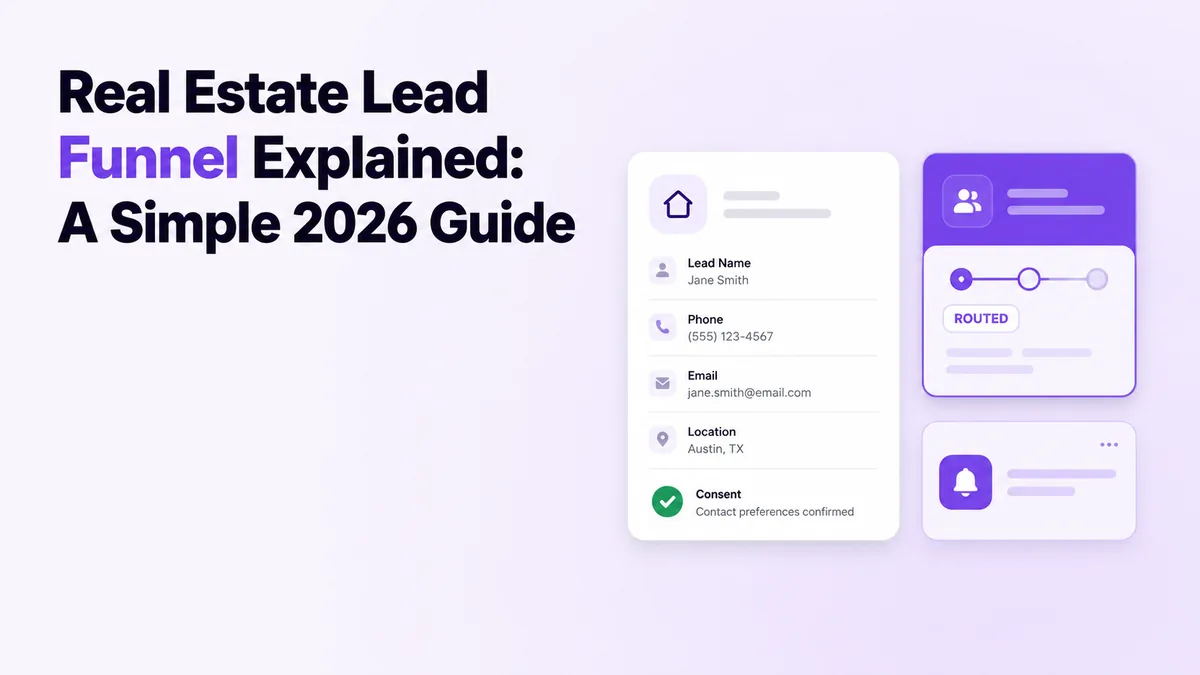
 Zegham AliApr 4, 2026
Real estate leads fall through the cracks because capturing an inquiry is easy, while assigning ownership, responding quickly, and maintaining follow-up across a long decision cycle are operational jobs. In 2023, Zillow found that 53% of surveyed buyers who contacted an agent spoke with at least two, while 47% hired the first or only agent they contacted (Zillow Group Population Science, Consumer Housing Trends Report 2023). A real estate lead funnel therefore has to do more than collect a name and email address; it has to move that person into an owned process before attention shifts elsewhere.
Speed matters, but speed without context creates another failure mode: a fast generic reply that ignores whether the person is a buyer, seller, investor, renter, or existing contact. In 2021, XANT reported that a cross-industry inbound lead converted at eight times the rate when the first response arrived within five minutes rather than after six minutes (XANT, Lead Response Management 2021). That is not a residential-real-estate benchmark, but it is a useful operating signal: route the lead, preserve the source and consent record, and make the next action unambiguous.
<figure> <style> .c1 { --surface:#fcfcfb; --ink-1:#0b0b0b; --ink-2:#52514e; --muted:#898781; --grid:#e1e0d9; --accent:#2a78d6; --accent-2:#1baf7a; --negative:#c05a3e; } .c1 text { font-family:system-ui, sans-serif; fill:var(--ink-1); } .c1 .ink2 { fill:var(--ink-2); } .c1 .muted { fill:var(--muted); } .c1 .grid { stroke:var(--grid); } @media (prefers-color-scheme: dark) { .c1 { --surface:#1a1a19; --ink-1:#ffffff; --ink-2:#c3c2b7; --muted:#898781; --grid:#2c2c2a; --accent:#3987e5; --accent-2:#199e70; --negative:#d0674a; } } </style> <svg class='c1' viewBox='0 0 560 380' role='img' aria-label='Donut chart showing 47 percent hired the first or only agent contacted and 53 percent contacted two or more agents.'> <rect x='0' y='0' width='560' height='380' fill='var(--surface)'/> <text x='28' y='34' font-size='18' font-weight='700'>How Many Agents Buyers Contacted</text> <text x='28' y='56' font-size='12' class='ink2'>Share of surveyed buyers who contacted an agent</text> <circle cx='178' cy='205' r='100' fill='none' stroke='var(--grid)' stroke-width='40'/> <circle cx='178' cy='205' r='100' fill='none' stroke='var(--accent)' stroke-width='40' stroke-dasharray='295.3 628.3' stroke-dashoffset='0' transform='rotate(-90 178 205)'/> <circle cx='178' cy='205' r='100' fill='none' stroke='var(--accent-2)' stroke-width='40' stroke-dasharray='333.0 628.3' stroke-dashoffset='-295.3' transform='rotate(-90 178 205)'/> <text x='178' y='202' text-anchor='middle' font-size='30' font-weight='700'>53%</text> <text x='178' y='224' text-anchor='middle' font-size='12' class='ink2'>contacted 2+</text> <rect x='326' y='142' width='16' height='16' rx='3' fill='var(--accent)'/> <text x='352' y='155' font-size='13'>First or only agent</text> <text x='510' y='155' text-anchor='end' font-size='16' font-weight='700'>47%</text> <rect x='326' y='190' width='16' height='16' rx='3' fill='var(--accent-2)'/> <text x='352' y='203' font-size='13'>Two or more agents</text> <text x='510' y='203' text-anchor='end' font-size='16' font-weight='700'>53%</text> <text x='28' y='352' font-size='11' class='muted'>Takeaway: a captured inquiry is not yet a secured client.</text> </svg> <figcaption>Source: Zillow Group Population Science, Consumer Housing Trends Report 2023.</figcaption> </figure>By the end of this guide, you will understand the complete path from form submission to CRM record, qualification, assignment, nurture, booking, and reporting—including the controls that stop duplicates, missed notifications, and unowned leads from quietly breaking the system.
A dependable funnel captures each inquiry, assigns a clear owner, and keeps following up until the prospect reaches a measurable outcome.

Photo by MART PRODUCTION on Pexels
A real estate lead funnel is the connected process that turns anonymous interest into a captured inquiry, a qualified prospect, an appointment, and eventually a client. In 2025, the National Association of REALTORS® reported that 88% of buyers purchased through an agent or broker and 91% of sellers used an agent (National Association of REALTORS®, 2025 Profile of Home Buyers and Sellers). The point of the funnel is not to replace the relationship; it is to make sure the relationship starts with the right context and does not disappear between systems.
A funnel answers what should happen next. Someone sees a listing, valuation offer, social post, ad, or referral page. They submit contact details and a reason for reaching out. The system checks the data, records consent, identifies the likely intent, creates or updates the CRM record, assigns responsibility, starts the right follow-up, and records whether the person books, pauses, declines, or converts.
Those stages are different from one another. Traffic is attention from a person who has not identified themselves. A captured inquiry is a person who has supplied contact information. A qualified lead has enough verified intent, timing, location, budget, or property information to justify a specific next action. An appointment is a scheduled conversation, valuation, consultation, or showing. A client is a person who has entered a formal working relationship or completed the transaction stage your business uses as conversion.
A landing page captures a response; the funnel governs everything after it. A page can ask for an address, phone number, preferred area, or viewing time, but it does not automatically decide whether an existing contact should be updated, which agent owns the record, what message is appropriate, or what happens when the first agent does not respond.
The difference becomes obvious during failure. If a form submits successfully but the CRM rejects the payload because a required field is missing, a page-only setup reports a conversion while the sales team receives nothing. A production funnel treats the submission, CRM write, assignment, notification, and acknowledgement as separate events. Each event has a status, an error path, and a recoverable next step.
The marketing funnel describes the prospect’s progression; the CRM pipeline describes the team’s work. The marketing view asks whether someone moved from awareness to inquiry, qualification, appointment, and client. The CRM view asks which record exists, who owns it, which stage it is in, what task is due, and which activity happened last.
The two views should share identifiers but not be confused. A prospect may be highly engaged in the marketing funnel while still sitting in an unassigned CRM stage because an automation failed. Conversely, a record may be marked “contacted” in the CRM even though the person never received a meaningful reply. Good reporting compares both: customer behavior and internal execution.
<iframe src="https://www.youtube-nocookie.com/embed/zqgQTQ7Av78" title="Real Estate Facebook ADS Strategy 2025🔥 | Get 5X Quality LEADS" loading="lazy" allowfullscreen></iframe>
Photo by cottonbro studio on Pexels
A real estate lead funnel works by passing one inquiry through a controlled sequence of capture, validation, CRM creation, qualification, assignment, follow-up, booking, and measurement. In 2025, the National Association of REALTORS® found that respondents most often named social media at 39%, CRM software at 23%, and local MLS systems at 17% as the technologies producing their highest number of quality leads (National Association of REALTORS®, 2025 REALTORS® Technology Survey). Those sources only become a funnel when their records arrive in one operating model.
<figure> <style> .c2 { --surface:#fcfcfb; --ink-1:#0b0b0b; --ink-2:#52514e; --muted:#898781; --grid:#e1e0d9; --accent:#2a78d6; --accent-2:#1baf7a; --negative:#c05a3e; } .c2 text { font-family:system-ui, sans-serif; fill:var(--ink-1); } .c2 .ink2 { fill:var(--ink-2); } .c2 .muted { fill:var(--muted); } .c2 .grid { stroke:var(--grid); } @media (prefers-color-scheme: dark) { .c2 { --surface:#1a1a19; --ink-1:#ffffff; --ink-2:#c3c2b7; --muted:#898781; --grid:#2c2c2a; --accent:#3987e5; --accent-2:#199e70; --negative:#d0674a; } } </style> <svg class='c2' viewBox='0 0 560 380' role='img' aria-label='Lollipop chart showing social media at 39 percent, CRM at 23 percent, local MLS at 17 percent, brokerage website at 13 percent, digital advertising and own business website at 12 percent each, email marketing tools at 11 percent, and listing portals at 9 percent.'> <rect x='0' y='0' width='560' height='380' fill='var(--surface)'/> <text x='28' y='34' font-size='18' font-weight='700'>Which Technologies Produce Quality Leads?</text> <text x='28' y='56' font-size='12' class='ink2'>Percent of REALTORS® naming each technology</text> <line x1='190' y1='72' x2='190' y2='322' class='grid' stroke-width='1'/> <line x1='267.5' y1='72' x2='267.5' y2='322' class='grid' stroke-width='1'/> <line x1='345' y1='72' x2='345' y2='322' class='grid' stroke-width='1'/> <line x1='422.5' y1='72' x2='422.5' y2='322' class='grid' stroke-width='1'/> <line x1='500' y1='72' x2='500' y2='322' class='grid' stroke-width='1'/> <text x='190' y='340' text-anchor='middle' font-size='11' class='muted'>0</text> <text x='267.5' y='340' text-anchor='middle' font-size='11' class='muted'>10</text> <text x='345' y='340' text-anchor='middle' font-size='11' class='muted'>20</text> <text x='422.5' y='340' text-anchor='middle' font-size='11' class='muted'>30</text> <text x='500' y='340' text-anchor='middle' font-size='11' class='muted'>40%</text> <text x='178' y='96' text-anchor='end' font-size='13'>Social media</text> <line x1='190' y1='92' x2='492.2' y2='92' stroke='var(--accent)' stroke-width='3' stroke-linecap='round'/> <circle cx='492.2' cy='92' r='7' fill='var(--accent)'/> <text x='506.2' y='97' text-anchor='start' font-size='15' font-weight='700'>39%</text> <text x='178' y='127' text-anchor='end' font-size='13'>CRM</text> <line x1='190' y1='123' x2='368.2' y2='123' stroke='var(--accent)' stroke-width='3' stroke-linecap='round'/> <circle cx='368.2' cy='123' r='7' fill='var(--accent)'/> <text x='382.2' y='128' text-anchor='start' font-size='15' font-weight='700'>23%</text> <text x='178' y='158' text-anchor='end' font-size='13'>Local MLS</text> <line x1='190' y1='154' x2='321.8' y2='154' stroke='var(--accent)' stroke-width='3' stroke-linecap='round'/> <circle cx='321.8' cy='154' r='7' fill='var(--accent)'/> <text x='335.8' y='159' text-anchor='start' font-size='15' font-weight='700'>17%</text> <text x='178' y='189' text-anchor='end' font-size='13'>Brokerage site</text> <line x1='190' y1='185' x2='290.8' y2='185' stroke='var(--accent)' stroke-width='3' stroke-linecap='round'/> <circle cx='290.8' cy='185' r='7' fill='var(--accent)'/> <text x='304.8' y='190' text-anchor='start' font-size='15' font-weight='700'>13%</text> <text x='178' y='220' text-anchor='end' font-size='13'>Digital ads</text> <line x1='190' y1='216' x2='283.0' y2='216' stroke='var(--accent)' stroke-width='3' stroke-linecap='round'/> <circle cx='283.0' cy='216' r='7' fill='var(--accent)'/> <text x='297.0' y='221' text-anchor='start' font-size='15' font-weight='700'>12%</text> <text x='178' y='251' text-anchor='end' font-size='13'>Own website</text> <line x1='190' y1='247' x2='283.0' y2='247' stroke='var(--accent)' stroke-width='3' stroke-linecap='round'/> <circle cx='283.0' cy='247' r='7' fill='var(--accent)'/> <text x='297.0' y='252' text-anchor='start' font-size='15' font-weight='700'>12%</text> <text x='178' y='282' text-anchor='end' font-size='13'>Email tools</text> <line x1='190' y1='278' x2='275.2' y2='278' stroke='var(--accent)' stroke-width='3' stroke-linecap='round'/> <circle cx='275.2' cy='278' r='7' fill='var(--accent)'/> <text x='289.2' y='283' text-anchor='start' font-size='15' font-weight='700'>11%</text> <text x='178' y='313' text-anchor='end' font-size='13'>Listing portal</text> <line x1='190' y1='309' x2='259.8' y2='309' stroke='var(--accent)' stroke-width='3' stroke-linecap='round'/> <circle cx='259.8' cy='309' r='7' fill='var(--accent)'/> <text x='273.8' y='314' text-anchor='start' font-size='15' font-weight='700'>9%</text> <text x='28' y='366' font-size='11' class='muted'>Social media leads the list; CRM ranks second.</text> </svg> <figcaption>Source: National Association of REALTORS®, 2025 REALTORS® Technology Survey.</figcaption> </figure>Capture the lead with the context needed to respond correctly. A property inquiry should carry the property identifier, page URL, campaign source, preferred viewing window, and any message the prospect entered. A valuation form should carry the property address, ownership status, selling timeframe, and the permission language shown at submission. A buyer form may need target area, price range, financing readiness, and move timing.
The form should create a durable event before it triggers downstream work. That event needs a unique submission identifier, timestamp, source, consent text or consent version, and the raw fields received. Storing the raw event matters because field mapping can change later. If the CRM receives “Downtown” in an area field that was recently renamed, the original payload helps you repair the mapping without asking the lead to submit again.
Consent should be channel-specific. Permission to email does not automatically mean permission to send text messages, and a checkbox should not be preinterpreted as broader consent than the page disclosed. When a system uses an SMS provider such as Twilio’s messaging platform, the workflow should pass the consent status alongside the phone number and block message steps when that status is missing or unclear.
Bot and spam controls belong here too, but they should not become a black box. A challenge tool such as Google reCAPTCHA can help score suspicious submissions, while server-side checks can reject obviously malformed email addresses, impossible phone lengths, repeated payloads, or bursts from the same source. The safe pattern is to quarantine doubtful records for review rather than silently treating every unusual submission as real or every repeated submission as fraud.
Create or update one clean CRM record instead of adding another duplicate. Validation normalizes phone numbers, trims text fields, standardizes locations, and checks whether required information is usable. Deduplication then looks for an existing person by stable identifiers such as normalized email, phone, or a known portal contact ID.
The practical operation is an upsert—update when the person already exists, insert when they do not. In HubSpot’s developer platform, that usually means working with contact properties, associations, and event or form data; in Salesforce developer documentation, the comparable design often uses Lead or Contact records, assignment logic, and custom fields. The important decision is not which CRM name appears on the box. It is which system owns the canonical person record and which identifiers every other tool must preserve.
Tagging should describe facts, not guesses. Useful tags include source, inquiry type, property, market, buyer or seller branch, financing state, timeframe, language, and consent channel. Avoid a single “hot lead” label with no explanation. A score is more defensible when it is built from visible inputs: a near-term move, a complete property address, a confirmed financing step, or repeated engagement with the same listing.
Field standards prevent later reporting from becoming unreliable. A seller timeframe should use one controlled set of values rather than a mix of “ASAP,” “soon,” “next few months,” and free-form notes. The same is true for lead source. Keep both the raw source value and a normalized reporting category so attribution can survive inconsistent portal names and campaign tags.
Route the lead to one accountable owner and create a deadline the system can inspect. Assignment can follow geography, property, language, service line, availability, workload, or an existing relationship. The rule should be deterministic enough that another operator can explain why a lead went to a particular agent.
Routing is not complete when an owner field is populated. The funnel should also create a task, send a notification through the channel the team actually monitors, and record the deadline. A useful status model distinguishes assigned, acknowledged, attempted, connected, qualified, booked, nurture, and closed. “Contacted” alone is too vague because it can mean a task was created, an email was sent, a voicemail was left, or a real conversation occurred.
Reassignment needs an explicit trigger. If the owner does not acknowledge or complete the first action before the deadline, the workflow can notify a coordinator, move the task to a backup queue, or assign the lead to the next eligible agent. The original owner and reason for reassignment should remain in the audit trail. Otherwise, managers see only the final owner and cannot tell whether the lead waited unhandled.
A workflow engine such as Zapier’s platform can connect forms, CRMs, messaging tools, and calendars, but the production design still needs idempotency—meaning the same event can be received again without creating another task, another record, and another welcome message. Use the submission ID or source event ID as the key, then store the result of each downstream action. Retries should resume from the failed step rather than replay the whole funnel.
Continue with a branch that matches the lead’s intent and stop when the person changes state. A seller who wants a valuation needs evidence, timing questions, and a route to a valuation appointment. A buyer asking about one property needs availability, comparable options if it is unavailable, and a route to a showing or consultation. A long-horizon prospect needs useful updates and a future review date, not the same urgent message repeated indefinitely.
The nurture sequence should react to behavior. A reply pauses automated follow-up and hands the conversation to the owner. A booked appointment closes outstanding booking tasks. An unsubscribe blocks promotional messages while preserving the CRM record and required compliance history. A returned email or invalid phone marks the channel as unusable and creates a data-quality task rather than allowing the sequence to continue failing silently.
Scheduling tools can remove the back-and-forth after qualification. With Calendly’s developer platform, a workflow can offer the correct event type, capture routing information, and listen for scheduled, rescheduled, or canceled events. The CRM should receive the appointment identifier, time, assigned host, and current status so the calendar is not treated as a separate truth.
Attribution needs both the first meaningful source and the later touch that produced the appointment. A person may first arrive from social media, return through a listing portal, and finally book from an email. If the system overwrites the source on every visit, acquisition reporting becomes unstable. Keep original source, latest source, campaign, property, and conversion event as separate fields.
Failure handling is part of the funnel, not an admin detail. Every external write should return a result that can be logged as succeeded, failed, retrying, or sent to manual review. Alerts should name the lead, failed step, error, and last successful step. That gives an operator enough context to repair the handoff without searching across several tools.
The best lead funnel builders for real estate agents are the ones that match the required control level, not the ones with the longest feature list. A simple team may need a form, CRM, and booking path. A multi-market operation may need custom routing, consent controls, fallback ownership, audit logs, and data reconciliation that a page builder alone cannot provide.
| Setup | Best fit | Where it works well | Main tradeoff |
|---|---|---|---|
| Custom workflow | Teams with several lead sources, branches, owners, or compliance rules | Precise field mapping, routing, retries, audit history, and unusual CRM logic | Requires deliberate design, testing, and maintenance |
| All-in-one funnel builder | Small teams that want pages, basic CRM, email, and booking in one place | Faster initial setup and fewer separate accounts | Advanced deduplication, reassignment, and reporting can be constrained by the platform model |
| Form or landing-page tool | A focused campaign that already has a dependable CRM process behind it | Good capture experience and quick campaign launch | Does not by itself solve ownership, follow-up, failure recovery, or source-of-truth questions |
The architecture should be chosen after mapping the events and ownership rules. Starting with a tool and forcing the business process into its default stages usually hides the hard questions until leads are already arriving.

Photo by Ivan S on Pexels
The most useful real estate funnel examples differ in trigger, qualification, ownership, and next action rather than merely changing the email copy. In an undated HubSpot customer case study, Accommodation.co.uk reported that monthly landlord valuation leads rose from about 35 to more than 1,200, valuation conversion increased from 5.6% to 8.6%, and tenant inquiry-to-viewing conversion moved from 18% to 53% (HubSpot, Accommodation.co.uk customer case study). That is one company’s measured case, not a universal forecast, but it shows why capture volume and stage conversion should be tracked separately.
A seller valuation funnel should qualify the property and the owner’s timing before pushing for an appointment. The trigger is usually an address submission, valuation request, or seller guide form. The first record should include the property address, ownership confirmation, property type, reason for moving, expected timeframe, and preferred contact channel.
The CRM branch can tag the lead as seller, attach the property record, and score completeness and urgency. A complete address with a near-term timeframe may route directly to the local listing specialist. A vague request with a distant horizon may enter a lower-frequency education path covering preparation, documents, pricing inputs, and local market updates.
The conversion goal is not “email opened.” It is a completed valuation conversation or booked visit. The funnel should stop promotional follow-up when an agent begins a real conversation, but it should keep operational reminders for missing documents, appointment confirmation, and rescheduling. If several owners submit the same property through different forms, deduplication should connect them to one property record while preserving each person’s consent and relationship.
A property inquiry funnel should respond to the exact listing first, then branch based on availability and buyer readiness. The trigger carries a listing ID, portal or campaign source, message, and contact details. The workflow looks up the property status, identifies the responsible agent, and sends an acknowledgement that refers to the correct property rather than a generic “thanks for your interest.”
If the listing is available, the lead receives qualifying questions and a booking path. If it is unavailable, the system can offer comparable properties based on area, budget, and property type without pretending the original listing is still open. A no-response branch can send a helpful follow-up, then move the record into nurture with a future review date instead of leaving an endless sequence active.
The operational edge case is concurrent activity. A property may change status after the inquiry arrives but before the agent replies. The workflow should recheck availability before a showing is confirmed and preserve the status seen at submission for audit. That prevents the CRM from making the earlier response look irrational when the underlying listing changed.
Real estate lead generation funnel with CRM routing, lead scoring, and appointment follow-up automation.
A first-time buyer funnel should separate education needs from immediate purchase readiness. In 2025, Zillow found that first-time and repeat prospective buyers were at different stages: 40% versus 53% had contacted an agent, 26% versus 38% had sought financing approval, 34% versus 43% had toured, and 19% versus 37% had made an offer (Zillow Group Population Science, Consumer Housing Trends Report 2025). Treating both groups as though they need the same next message ignores those readiness differences.
<figure> <style> .c3 { --surface:#fcfcfb; --ink-1:#0b0b0b; --ink-2:#52514e; --muted:#898781; --grid:#e1e0d9; --accent:#2a78d6; --accent-2:#1baf7a; --negative:#c05a3e; } .c3 text { font-family:system-ui, sans-serif; fill:var(--ink-1); } .c3 .ink2 { fill:var(--ink-2); } .c3 .muted { fill:var(--muted); } .c3 .grid { stroke:var(--grid); } @media (prefers-color-scheme: dark) { .c3 { --surface:#1a1a19; --ink-1:#ffffff; --ink-2:#c3c2b7; --muted:#898781; --grid:#2c2c2a; --accent:#3987e5; --accent-2:#199e70; --negative:#d0674a; } } </style> <svg class='c3' viewBox='0 0 560 380' role='img' aria-label='Grouped bar chart showing first-time versus repeat prospective buyers: viewed homes online 66 versus 72 percent, contacted an agent 40 versus 53 percent, obtained financing approval 26 versus 38 percent, toured a property 34 versus 43 percent, and made an offer 19 versus 37 percent.'> <rect x='0' y='0' width='560' height='380' fill='var(--surface)'/> <text x='28' y='34' font-size='18' font-weight='700'>Buyer Progress by Buyer Type</text> <text x='28' y='56' font-size='12' class='ink2'>First-time and repeat prospective buyers, percent</text> <rect x='332' y='24' width='12' height='12' rx='2' fill='var(--accent)'/> <text x='350' y='34' font-size='11'>First-time</text> <rect x='422' y='24' width='12' height='12' rx='2' fill='var(--accent-2)'/> <text x='440' y='34' font-size='11'>Repeat</text> <line x1='70' y1='300' x2='520' y2='300' class='grid' stroke-width='1'/> <line x1='70' y1='250' x2='520' y2='250' class='grid' stroke-width='1'/> <line x1='70' y1='200' x2='520' y2='200' class='grid' stroke-width='1'/> <line x1='70' y1='150' x2='520' y2='150' class='grid' stroke-width='1'/> <line x1='70' y1='100' x2='520' y2='100' class='grid' stroke-width='1'/> <text x='60' y='304' text-anchor='end' font-size='11' class='muted'>0</text> <text x='60' y='254' text-anchor='end' font-size='11' class='muted'>20</text> <text x='60' y='204' text-anchor='end' font-size='11' class='muted'>40</text> <text x='60' y='154' text-anchor='end' font-size='11' class='muted'>60</text> <text x='60' y='104' text-anchor='end' font-size='11' class='muted'>80%</text> <rect x='83' y='135.0' width='26' height='165.0' rx='3' fill='var(--accent)'/> <rect x='115' y='120.0' width='26' height='180.0' rx='3' fill='var(--accent-2)'/> <text x='96' y='128.0' text-anchor='middle' font-size='15' font-weight='700'>66</text> <text x='128' y='113.0' text-anchor='middle' font-size='15' font-weight='700'>72</text> <text x='112' y='322' text-anchor='middle' font-size='11' class='ink2'>Viewed</text> <rect x='173' y='200.0' width='26' height='100.0' rx='3' fill='var(--accent)'/> <rect x='205' y='167.5' width='26' height='132.5' rx='3' fill='var(--accent-2)'/> <text x='186' y='193.0' text-anchor='middle' font-size='15' font-weight='700'>40</text> <text x='218' y='160.5' text-anchor='middle' font-size='15' font-weight='700'>53</text> <text x='202' y='322' text-anchor='middle' font-size='11' class='ink2'>Agent</text> <rect x='263' y='235.0' width='26' height='65.0' rx='3' fill='var(--accent)'/> <rect x='295' y='205.0' width='26' height='95.0' rx='3' fill='var(--accent-2)'/> <text x='276' y='228.0' text-anchor='middle' font-size='15' font-weight='700'>26</text> <text x='308' y='198.0' text-anchor='middle' font-size='15' font-weight='700'>38</text> <text x='292' y='322' text-anchor='middle' font-size='11' class='ink2'>Financing</text> <rect x='353' y='215.0' width='26' height='85.0' rx='3' fill='var(--accent)'/> <rect x='385' y='192.5' width='26' height='107.5' rx='3' fill='var(--accent-2)'/> <text x='366' y='208.0' text-anchor='middle' font-size='15' font-weight='700'>34</text> <text x='398' y='185.5' text-anchor='middle' font-size='15' font-weight='700'>43</text> <text x='382' y='322' text-anchor='middle' font-size='11' class='ink2'>Toured</text> <rect x='443' y='252.5' width='26' height='47.5' rx='3' fill='var(--accent)'/> <rect x='475' y='207.5' width='26' height='92.5' rx='3' fill='var(--accent-2)'/> <text x='456' y='245.5' text-anchor='middle' font-size='15' font-weight='700'>19</text> <text x='488' y='200.5' text-anchor='middle' font-size='15' font-weight='700'>37</text> <text x='472' y='322' text-anchor='middle' font-size='11' class='ink2'>Offer</text> <text x='28' y='358' font-size='11' class='muted'>Repeat buyers were further along at every measured action.</text> </svg> <figcaption>Source: Zillow Group Population Science, Consumer Housing Trends Report 2025.</figcaption> </figure>The trigger may be a first-buyer checklist, affordability tool, mortgage-readiness form, or request for listings. Qualification should ask about target area, rough budget, current financing step, move window, and the main uncertainty blocking action. The CRM can tag the person as first-time and branch to financing education, an agent consultation, or property alerts according to the answers.
A practical buyer-versus-seller branch looks like this:
| Branch | Qualification focus | First owned action | Conversion goal |
|---|---|---|---|
| Seller | Property, ownership, condition, motivation, and timing | Local specialist reviews the property context and confirms the valuation path | Valuation consultation or listing appointment |
| Property-specific buyer | Listing, availability, budget, financing state, and showing window | Assigned agent confirms the property and offers a relevant booking route | Showing or buyer consultation |
| First-time buyer | Readiness, financing step, area, budget, and knowledge gaps | Agent or mortgage partner addresses the blocking question | Qualified consultation and a documented next milestone |
Generic nurture sequences often underperform because they are organized around elapsed time rather than the prospect’s unresolved decision. The better trigger is a state change: financing approved, property preference updated, selling window shortened, appointment canceled, or reply received.
In an undated Calendly mortgage customer case, Churchill Mortgage reported that state-based routing and scheduling were associated with 26,767 reclaimed hours and a reported 1,037% return within one year (Calendly, Churchill Mortgage customer case study). The transferable lesson is the mechanism—route by a known attribute, present the correct scheduler, and write the booking result back—not the case-specific return.
A real estate lead funnel matters because it turns lead handling into a measurable operating process instead of a collection of personal reminders. In 2025, Zillow reported that 59% of prospective buyers had been shopping for at least six months (Zillow Group Population Science, Consumer Housing Trends Report 2025). Ownership, nurture, and reporting therefore have to persist well beyond the first inquiry.
Fast response improves the first impression only when one person clearly owns the next step. In 2023, Zillow found that 81% of surveyed buyers rated a responsive initial impression as very or extremely important, matching the 2022 reading after 75% in 2020 and 73% in 2021 (Zillow Group Population Science, Consumer Housing Trends Report 2023).
<figure> <style> .c4 { --surface:#fcfcfb; --ink-1:#0b0b0b; --ink-2:#52514e; --muted:#898781; --grid:#e1e0d9; --accent:#2a78d6; --accent-2:#1baf7a; --negative:#c05a3e; } .c4 text { font-family:system-ui, sans-serif; fill:var(--ink-1); } .c4 .ink2 { fill:var(--ink-2); } .c4 .muted { fill:var(--muted); } .c4 .grid { stroke:var(--grid); } @media (prefers-color-scheme: dark) { .c4 { --surface:#1a1a19; --ink-1:#ffffff; --ink-2:#c3c2b7; --muted:#898781; --grid:#2c2c2a; --accent:#3987e5; --accent-2:#199e70; --negative:#d0674a; } } </style> <svg class='c4' viewBox='0 0 560 380' role='img' aria-label='Line chart showing the share of buyers rating a responsive first impression very or extremely important: 80 percent in 2018, 75 percent in 2020, 73 percent in 2021, 81 percent in 2022, and 81 percent in 2023.'> <rect x='0' y='0' width='560' height='380' fill='var(--surface)'/> <text x='28' y='34' font-size='18' font-weight='700'>Responsiveness Remains Highly Important</text> <text x='28' y='56' font-size='12' class='ink2'>Buyers rating responsiveness very or extremely important</text> <line x1='70' y1='300' x2='520' y2='300' class='grid' stroke-width='1'/> <line x1='70' y1='233.3' x2='520' y2='233.3' class='grid' stroke-width='1'/> <line x1='70' y1='166.7' x2='520' y2='166.7' class='grid' stroke-width='1'/> <line x1='70' y1='100' x2='520' y2='100' class='grid' stroke-width='1'/> <text x='60' y='304' text-anchor='end' font-size='11' class='muted'>70</text> <text x='60' y='237.3' text-anchor='end' font-size='11' class='muted'>75</text> <text x='60' y='170.7' text-anchor='end' font-size='11' class='muted'>80</text> <text x='60' y='104' text-anchor='end' font-size='11' class='muted'>85%</text> <polyline points='90,180.0 190,240.0 290,264.0 390,168.0 490,168.0' fill='none' stroke='var(--accent)' stroke-width='2.5' stroke-linejoin='round' stroke-linecap='round'/> <circle cx='90' cy='180.0' r='4' fill='var(--accent)'/> <text x='90' y='322' text-anchor='middle' font-size='11' class='ink2'>2018</text> <text x='90' y='168.0' text-anchor='middle' font-size='16' font-weight='700'>80%</text> <circle cx='190' cy='240.0' r='4' fill='var(--accent)'/> <text x='190' y='322' text-anchor='middle' font-size='11' class='ink2'>2020</text> <circle cx='290' cy='264.0' r='4' fill='var(--accent)'/> <text x='290' y='322' text-anchor='middle' font-size='11' class='ink2'>2021</text> <circle cx='390' cy='168.0' r='4' fill='var(--accent)'/> <text x='390' y='322' text-anchor='middle' font-size='11' class='ink2'>2022</text> <circle cx='490' cy='168.0' r='4' fill='var(--accent)'/> <text x='490' y='322' text-anchor='middle' font-size='11' class='ink2'>2023</text> <text x='490' y='156.0' text-anchor='middle' font-size='16' font-weight='700'>81%</text> <text x='28' y='358' font-size='11' class='muted'>The measure returned to 81% in 2022 and held in 2023.</text> </svg> <figcaption>Source: Zillow Group Population Science, Consumer Housing Trends Report 2023.</figcaption> </figure>The metric to watch is not simply “notification sent.” Track time from submission to assignment, assignment to acknowledgement, acknowledgement to first attempt, and first attempt to meaningful connection. Those intervals show whether the delay is in software, workload, or agent behavior.
Ownership also needs an exception path. When an agent is unavailable, overloaded, or outside the correct territory, the system should reassign the lead and record why. A queue with no fallback is still an unowned process, even when every record technically has an owner field.
Qualification helps the team spend attention according to intent and readiness rather than treating every form submission as equal. In 2025, Zillow’s prospective-buyer survey showed a progression from 67% viewing listings to 48% contacting an agent, 34% seeking financing approval, 39% touring, and 31% making an offer (Zillow Group Population Science, Consumer Housing Trends Report 2025). Those figures describe the surveyed population, not universal funnel targets, but they illustrate why “lead” can represent very different stages.
A useful score explains itself. Instead of assigning a mysterious label, record the factors: complete contact information, target location, specific property, stated timeframe, financing stage, prior engagement, or seller property details. The owner can then see why the lead was prioritized and correct the record when new information arrives.
Lead volume can rise while business quality falls. A campaign that produces many incomplete submissions may look successful at the top of the funnel and create little agent value. Compare source-by-source rates for valid contact data, owner acknowledgement, real conversations, qualified appointments, and closed outcomes before deciding which channel deserves more spend.
Consistent follow-up keeps the relationship active without forcing every prospect into an urgent sequence. In 2025, the National Association of REALTORS® reported that successful buyers searched for a median of 10 weeks (National Association of REALTORS®, 2025 Profile of Home Buyers and Sellers). Zillow’s broader prospective-buyer data shows that many people remain in market even longer, so the workflow needs both immediate response and long-cycle nurture.
Consistency does not mean sending the same message on a fixed cadence regardless of behavior. It means every record has a current state, owner, next review date, valid contact channel, and reason for the next touch. A reply, booking, changed timeframe, unavailable property, or financing milestone should alter the sequence.
The cost of poor follow-up shows up in relationship loss. In 2023, Zillow reported that 26% of surveyed buyers switched agents; among those switchers, 40% cited difficult communication and 48% said the agent did little work (Zillow Group Population Science, Consumer Housing Trends Report 2023). A visible activity trail helps the team distinguish real work from assumed work and catch stalled relationships before the prospect leaves.
A useful scorecard ties each customer stage to an internal event, an owner, and a measurable next outcome. The goal is not to copy a benchmark blindly. It is to find where your own records stop moving and determine whether the cause is traffic quality, bad data, slow handling, weak qualification, or poor follow-up.
| Stage | Event to count | Rate or interval to monitor | What a leak usually suggests |
|---|---|---|---|
| Capture | Valid inquiry stored with source and consent | Valid records compared with total submissions | Form friction, spam, broken validation, or low-intent traffic |
| CRM creation | Contact and property records created or updated | Successful CRM writes compared with valid inquiries | Field mapping errors, required-field failures, or duplicate logic problems |
| Assignment | Owner and deadline recorded | Assignment delay and unassigned records | Missing territory rules, unavailable owners, or workflow failures |
| First response | Acknowledgement and real contact attempt recorded | Response interval and meaningful connection rate | Slow ownership, ignored tasks, or unsuitable contact channels |
| Qualification | Intent, timing, budget, property, or financing state confirmed | Qualified records compared with connected leads | Weak questions, poor source quality, or inconsistent agent notes |
| Appointment | Showing, valuation, or consultation booked | Booking rate and cancellation recovery | Too much scheduling friction or an unclear next step |
| Nurture | Future review date and relevant sequence active | Completed follow-ups, replies, and reactivated records | Generic messaging, stale data, or no state-based branching |
| Outcome | Client, lost, paused, or disqualified reason recorded | Outcomes by source, owner, branch, and campaign | Attribution gaps or stages that hide unresolved records |
Diagnose the earliest abnormal stage first. If valid inquiries are reaching the CRM but assignments are delayed, changing ad copy will not fix the leak. If assignments are fast but meaningful conversations are rare, inspect data quality, channel preference, message relevance, and agent availability. If conversations happen but appointments do not, examine qualification and the booking handoff.
The fastest first action is to map one real inquiry from source to final status and mark every system write, owner change, deadline, and failure path. That exercise usually exposes duplicate records, ambiguous ownership, and missing events before a platform decision does.
A real estate lead funnel works best when it is treated as a connected operating system, not a landing page followed by a collection of reminders. In 2023, Zillow found that 53% of surveyed buyers who contacted an agent spoke with at least two, which is why the decisive advantage is often timely ownership and relevant follow-up rather than capture alone (Zillow Group Population Science, Consumer Housing Trends Report 2023). For teams that need capture, CRM routing, scoring, follow-up, and booking to behave as one dependable path, CogWorkLabs’ [real estate lead funnels](https://www.cogworklabs.com/services/Workflow Automation/automated-lead-generation-real-estate) provide a practical implementation reference.
See how mortgage marketing automation uses CRM triggers to run borrower and Realtor journeys, protect compliance, and measure results beyond clicks alone.
Awais ShahidApr 22, 2026
Learn how to design a ClickUp automation workflow that reduces manual handoffs, connects HubSpot, adds AI support, and improves agency quality control.
Zegham AliApr 24, 2026
Learn how HubSpot AI assistant integrate with email marketing workflows using CRM context, review gates, GDPR controls, follow-ups, and document tracking.
 Mughees RehmanApr 18, 2026