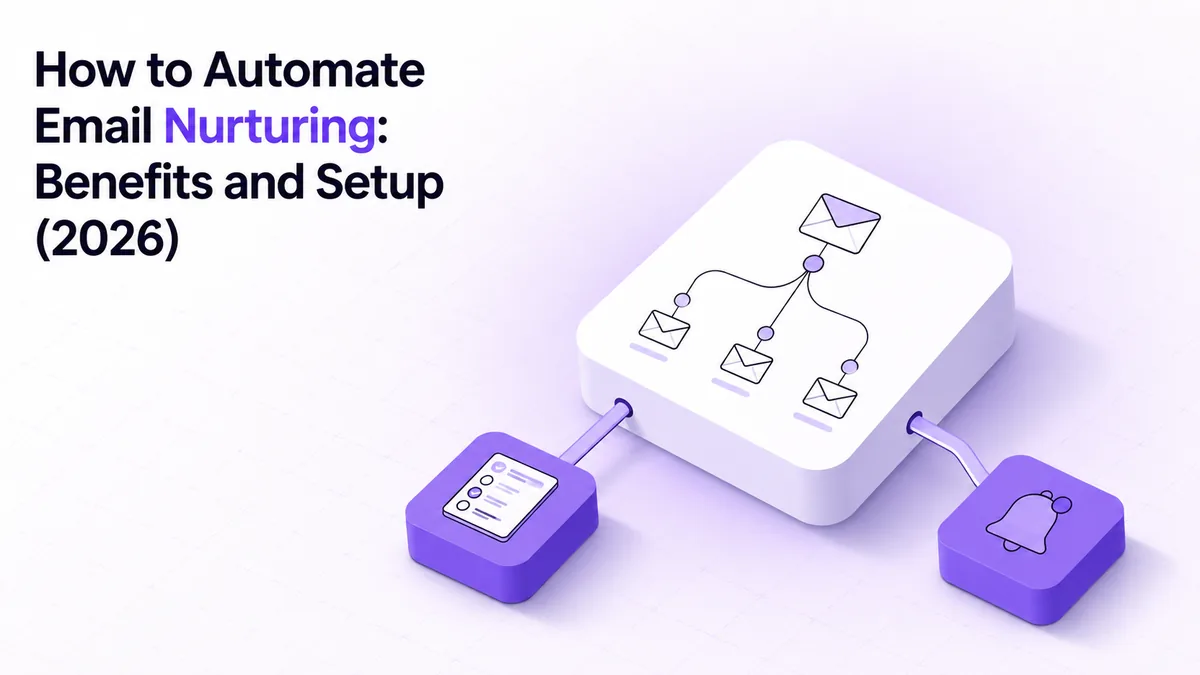
How to Automate Email Nurturing: Benefits and Setup (2026)
Why customer nurturing breaks as your list grows
Customer nurturing breaks when rising lead volume makes timely, relevant follow-up impossible to manage by hand. The benefits of email automation for customer nurturing come from responding while interest is still fresh, routing people according to what they need, and recording what happens after every message.
In 2021, InsideSales found that inbound leads contacted within five minutes converted at more than eight times the rate of leads first approached later in the first day (InsideSales, Lead Response Study). The study is older than the preferred research window, but the mechanism remains useful: delay allows attention to move elsewhere.
Source: InsideSales Lead Response Study, 2021.
Email automation is the use of predefined rules to send or change messages when a person reaches a particular point in a customer journey. It does not make weak messaging persuasive or repair a mismatched offer. It removes the delay and inconsistency that appear when staff must notice every form submission, quiz result, email click, or checkout event themselves.
I have audited funnels that were technically active but commercially ineffective. Messages were leaving on schedule, yet beginner subscribers received advanced offers, repeat buyers re-entered welcome sequences, and sales could not be traced back to a segment or email. The automation was running; the nurturing logic was not.
The central takeaway: automate the decision path, not merely the send button. Useful nurturing requires current segment data, behavior-based timing, relevant offers, and event tracking from initial signup through purchase.
Key takeaways
Automated nurturing creates value when it sends fewer, better-timed messages and makes their commercial effect measurable.
Speed matters: follow-up should begin when the qualifying event occurs, not when someone reviews a spreadsheet.
Segmentation controls relevance: different needs require different sequences, examples, and offers.
Behavior should change the path: clicks, purchases, inactivity, and checkout events should affect what happens next.
Revenue matters more than volume: in 2026, Omnisend reported that automated email accounted for 2% of sends but produced 30% of email-driven revenue in its 2025 ecommerce dataset (Omnisend, 2026 Ecommerce Marketing Report).
Measurement starts between stages: track where each segment stops progressing, not just whether an email was opened.
Benefits of email automation for customer nurturing
The main benefits are faster follow-up, more relevant communication, consistent journey progression, clearer diagnosis, and more opportunities to connect interest with an appropriate offer. In 2026, Omnisend reported that automated messages earned $2.87 per send, compared with $0.18 for scheduled campaigns in its 2025 ecommerce data (Omnisend, 2026 Ecommerce Marketing Report).
Those figures describe a dataset, not a guaranteed result. Automation performs well because messages are usually tied to stronger intent signals: a signup, product view, quiz outcome, abandoned checkout, renewal date, or previous purchase. Poor data, weak offers, excessive sending, and damaged deliverability can erase the advantage.
Immediate follow-up protects the attention a lead has already given you. A form submission can enter a journey as soon as the data reaches the email platform, while a delayed manual process may leave the contact untouched until someone has time to review it.
The practical gain is not simply saved staff time. Automation applies the same response rule on busy days, during weekends, and when lead volume spikes. A subscriber can receive the correct welcome message, educational sequence, or qualification question without waiting for a campaign calendar.
Timing should still reflect the event. A requested guide may justify an immediate delivery email. A sales-heavy offer sent seconds after an early-stage quiz can feel abrupt. The system should separate speed of acknowledgement from speed of promotion.
More relevant messages for each audience segment
Segmentation makes the sequence reflect what the subscriber has told you. A segment is a group defined by stored attributes or behavior, such as skill level, product interest, location, account stage, purchase history, or engagement.
In 2024, Twilio Segment found that 89% of surveyed business leaders considered personalization crucial to business success over the following three years (Twilio Segment, State of Personalization Report 2024). Personalization here should mean more than inserting a first name. The useful version changes the explanation, proof, offer, or next question according to a meaningful difference.
For example, a beginner may need terminology, an initial checklist, and a low-commitment product. An experienced subscriber may need implementation details, constraints, and a more advanced offer. Sending both people the same sequence forces the copy to become too broad for either.
A clearer path from interest to the right offer
Automated progression connects small signals of intent to the next suitable step. A subscriber who completes an introductory lesson may continue through education, while someone who views an advanced product or starts checkout can move to a more specific branch.
A branch is a rule that sends contacts down different paths. The decision might inspect a segment field, email click, tracked website event, product purchase, or lack of activity. Exit rules are equally important: purchasers should stop receiving pre-purchase reminders, and disengaged contacts should not remain in an endless sequence.
The same principle clarifies lead nurturing automation comparisons between email, SMS, and social media. Email suits longer explanations, educational sequences, and owned audience records. SMS suits brief, time-sensitive notices but requires careful consent and frequency control. Social messaging can support conversational follow-up, but platform access and identity matching may be less predictable. Most mature journeys use each channel for the job it handles well rather than treating them as interchangeable.
Better evidence about what is helping or hurting sales
A tracked journey shows which segment, message, and offer contributed to movement. That evidence lets the team distinguish between a routing problem and a copy problem.
In February 2026, Klaviyo reported an average click rate of 5.58% for automated flows across industries, compared with 1.69% for one-off campaigns (Klaviyo, Email Marketing Benchmarks 2026). The comparison supports the value of intent-based messaging, but a team still needs its own baseline by segment and journey stage.
Program-level return can also be substantial. In its undated ROI guide, Litmus reports an average return of $36 for every $1 spent while stressing that results vary with program design and measurement (Litmus, Email Marketing ROI Guide). Treat that figure as evidence of email’s potential, not a forecast for a specific funnel.
Email automation for customer nurturing works by capturing an event, updating a reliable contact record, choosing a path, and recording the outcome. Make documents two relevant webhook execution behaviors: incoming instant-webhook runs are processed in parallel by default, while ordered processing can be enabled when sequence matters (Make, Webhooks Help Center).
A trigger is the event that starts an automation. A segment is a maintained audience group. A branch chooses one path from several. An event is a recorded action, such as completing a quiz, viewing an offer, beginning checkout, or purchasing.
In a Make-to-Brevo setup, Make usually handles movement and validation between systems, while Brevo owns the contact profile, email content, audience segments, automation state, and delivery reporting. Clear ownership prevents two systems from repeatedly overwriting the same field.
1. Capture the lead and keep the source data
Capture the original submission before transforming or routing it. A quiz, form, checkout, webinar registration, or application can send data into a Make webhook as soon as the event occurs.
The first processing step should preserve identifiers and context: email address, submission ID, source, consent status, submitted answers, campaign parameters, and event timestamp. Do not keep only the final segment label. When routing later looks wrong, the original input is what allows the team to reproduce the decision.
Validate required fields before writing to Brevo. Normalize email casing, reject empty identifiers, and map known answer values to controlled labels rather than copying arbitrary text into a segment field. Store the source event ID as an idempotency key—an identifier used to recognize a repeated request—so retries do not create repeated downstream actions.
Sequence matters when one contact can generate several events quickly. Because Make processes instant webhook runs in parallel by default, a later event may finish before an earlier one. Ordered processing or explicit timestamp checks are necessary when the newest event must win.
2. Assign the right segment and keep it current
Use one authoritative field for each routing decision. For a skill-based funnel, Brevo might own skill_level, while Make calculates its value from quiz answers and sends the update.
Brevo’s create-contact API supports an upsert-style pattern: when updateEnabled is set to true, the same request can update an existing contact instead of failing because the email already exists (Brevo, Create a Contact API). That reduces duplicate-record problems, but it does not resolve conflicting updates by itself.
Define field ownership before building:
The quiz owns raw answers and its submission ID.
Make owns normalization, validation, and routing calculations.
Brevo owns the current contact attributes used by automations.
The commerce system owns purchase and refund truth.
The reporting layer owns joined funnel events and attribution rules.
A segment should change when its underlying evidence changes. If a subscriber retakes a quiz, buys an advanced product, or is manually reclassified, the automation must decide whether to update the current journey, stop it, or allow completion before the next path begins.
3. Send messages based on timing and behavior
Combine scheduled delays with behavior checks instead of sending a fixed sequence blindly. A delay controls when the journey evaluates the next step; a condition checks whether the step is still appropriate.
Typical automated nurturing journey examples for email marketing workflows include a welcome path, an education path, a re-engagement path, an abandoned-checkout path, and a post-purchase path. Each should have explicit entry conditions, exit conditions, and re-entry rules.
A welcome journey might begin after confirmed consent, wait for the resource-delivery event, and then check whether the subscriber viewed the relevant offer. A purchase event should remove the contact from promotional reminders immediately. A lack of interaction may reduce frequency or move the subscriber to a broader newsletter rather than triggering increasingly urgent messages.
Do not rely on delays alone to represent customer state. The contact may act while the timer is running. Every important send should re-check current segment, purchase status, suppression status, and journey eligibility before delivery.
4. Match the offer and record every key result
Match each path to a specific offer and write the outcome back as an event. The offer should fit the subscriber’s demonstrated level, problem, and readiness—not merely the campaign the marketing team wants to promote.
Each event needs a contact identifier, segment at the time of the event, event timestamp, source journey, and relevant offer identifier. That history lets the reporting layer calculate movement and drop-off without guessing from current contact fields.
The technical gap many teams miss is recovery. Failed Make runs should enter a visible error path, preserve the payload, and support replay after the underlying problem is fixed. Brevo updates should return a recorded success or error response. A workflow is not maintainable if failures disappear into logs that nobody reviews.
Who gets the most value from automated nurturing
Automated nurturing is most useful for teams with repeatable journeys, meaningful audience differences, and enough activity to make manual follow-up unreliable. In 2024, Twilio Segment found that 89% of surveyed business leaders viewed personalization as crucial to business success over the next three years, which makes segmentation most valuable when a company has real differences to act on rather than cosmetic profile data (Twilio Segment, State of Personalization Report 2024).
Teams with a growing subscriber list
Growing lists benefit when staff can no longer review every new contact promptly. The exact list size matters less than the rate of new entries, the number of journeys, and the cost of delayed follow-up.
A small list may still justify automation when leads are valuable or arrive outside working hours. A larger list may need only a simple welcome sequence if every subscriber receives the same offer. Complexity should follow routing requirements, not vanity metrics.
Businesses selling different offers to different people
Multiple audiences create value when each segment genuinely needs a different next step. Online education, software, professional services, memberships, ecommerce, events, and subscription businesses often have clear differences in skill, use case, lifecycle stage, or purchase history.
Very small catalogs and one-off sales may not need elaborate branching. A short confirmation sequence and direct sales follow-up can be easier to maintain.
Workflow Automation
Sales Funnel Optimization Agency for Tiered Email Funnels
Hire a sales funnel optimization agency to audit and rebuild Make and Brevo journeys, match three skill segments to offers, and track drop-offs clearly.
Teams ready to measure behavior, not just email opens
The method fits teams willing to track offer views, checkout starts, purchases, exits, and suppression events. Open data alone is too uncertain for routing or commercial diagnosis.
Someone must also own the definitions. Marketing, sales, and operations should agree on what counts as a qualified entry, conversion, reactivation, and completed journey. Otherwise, different dashboards will report different answers.
What the tool stack must support
The best tools for automated email sequences and lead nurturing in 2026 should support branching, dynamic segments, event tracking, consent controls, integrations, failure visibility, and exportable reporting. A polished template library is useful, but it cannot replace reliable state and event handling.
Evaluate whether the platform can update contacts without duplication, stop contacts after purchase, re-enter them safely, expose delivery failures, and export enough event data for independent analysis. The best tools for lead nurturing email automation in 2026 are the ones your team can inspect, test, document, and support after launch.
Real-world example: rebuilding a three-level nurture funnel
A three-level nurture funnel should route beginner, intermediate, and expert subscribers into different educational paths while keeping the data model simple enough to audit. In November 2025, Mailchimp published a Madden Media and Destination Door County case study in which a segmented seasonal welcome series achieved a 54.4% open rate and 13.9% click-through rate, compared with 36.9% and 9.9% for the earlier non-seasonal series using 2024 campaign data (Mailchimp, Madden Media Traveler Engagement Case Study).
That external case demonstrates the potential value of relevant segmentation. It is not a result forecast for the illustrative funnel below.
Source: Mailchimp case study: Madden Media and Destination Door County, November 2025 (2024 campaign data).
Before: one working funnel with weak sales
The original funnel works mechanically but treats every quiz respondent as the same buyer. A visitor completes a skill assessment, Make sends the contact to Brevo, and Brevo starts one shared sequence promoting the same digital product.
The team sees submissions, email deliveries, and some purchases. It cannot answer which skill group buys, whether the product matches each group, or where people stop. A weak sales total could come from several different causes: incorrect quiz mapping, poor emails, an unsuitable offer, a broken checkout event, slow delivery, or low-quality traffic.
The first audit therefore follows one test contact through the full path. It compares the submitted answers, Make execution, Brevo contact record, assigned journey, delivered messages, offer link, checkout event, and final purchase record. Rebuilding before completing this trace risks replacing a working component while leaving the actual fault untouched.
Rebuild: three paths with level-matched offers
The rebuilt design preserves one shared data model but creates three clearly separated paths. The quiz sends raw answers and a submission ID to Make. Make validates the payload, calculates the level, and updates the contact in Brevo.
The routing rules are explicit:
Beginner: receives foundational explanations, an introductory checklist, and an entry-level product.
Intermediate: receives problem-specific examples, implementation guidance, and a product that assumes prior experience.
Expert: receives advanced methods, constraints, comparisons, and a higher-depth offer.
These are automated nurturing journey examples for email marketing, not fixed templates. The important mechanism is the match between evidence, sequence, and offer.
Every path uses the same core event names so reporting remains comparable. Segment and offer identifiers differ, but nurture_entered, offer_viewed, checkout_started, and purchase_completed mean the same thing across all paths.
Exit rules prevent overlap. A purchase stops pre-purchase promotion. A changed skill level triggers a documented transition policy. A missing segment sends the contact to a review queue or safe default instead of guessing.
After: the results the team should be able to verify
The rebuilt funnel succeeds when the team can verify routing and diagnose commercial movement for each level. Success is not defined by a visually impressive automation canvas.
The team should be able to select a test contact and confirm the original quiz submission, calculated level, Brevo fields, journey entry, sent messages, offer destination, checkout status, purchase status, and any failure or retry. It should also compare segment-level conversion without combining audiences that received different offers.
No client outcome needs to be invented. The measurable after state is better visibility: the team can identify whether beginner subscribers enter but do not click, intermediate subscribers view the offer but avoid checkout, or expert subscribers buy while receiving unnecessary introductory messages. Each pattern suggests a different repair.
How to tell whether the funnel is improving
A funnel is improving when a larger share of the intended segment moves from valid entry to purchase without unacceptable increases in bounces, complaints, or unsubscribes. In 2026, Omnisend reported that email click-to-conversion increased from 5.9% in 2024 to 9.0% in 2025, a 53% year-over-year increase in its ecommerce dataset (Omnisend, 2026 Ecommerce Marketing Report).
That benchmark shows why post-click behavior matters. A higher click rate is not useful if the offer page, checkout, or segment match prevents the click from becoming a sale.
Conversion rate for each segment
Calculate conversion separately for every segment and offer combination. Divide completed purchases by valid nurture entries for the same segment, journey version, and observation window.
Do not combine beginner, intermediate, and expert contacts if they received different products or message sequences. A blended rate can improve while one important group deteriorates. Record the journey version so a later copy change does not overwrite the history of the previous version.
Drop-off between quiz, nurture, offer, checkout, and sale
Measure the loss between consecutive events, not only the final purchase rate. The event chain should reveal whether contacts failed to enter, ignored the nurture, avoided the offer, abandoned checkout, or completed payment without being recorded.
Common surface metric
Deeper diagnostic measure
Question it answers
Total subscribers
Valid journey-entry rate by segment
Did eligible contacts enter the correct path?
Overall click rate
Offer-view rate by segment and message
Which audience and message generated qualified interest?
Checkout totals
Checkout-start rate after offer view
Did the offer page create enough intent to proceed?
Revenue
Purchase rate by segment, offer, and journey version
Which path produced the commercial result?
Open rate
Delivered-to-click and click-to-conversion rates
Did people act, regardless of tracking noise?
Unsubscribes
Unsubscribe rate by message and segment
Which message created resistance or fatigue?
Deliverability and engagement warning signs
Use click, bounce, complaint, unsubscribe, and conversion data together. In May 2026, Brevo reported a 2.27% average marketing-email click-through rate and 5.22% for top-performing campaigns in its 2025 data (Brevo, Marketing Orchestration Benchmark 2026).
Benchmarks are reference points, not pass/fail thresholds. A high-intent customer sequence may exceed a broad marketing benchmark, while a long educational sequence may produce lower clicks but better eventual conversion.
Open rates require extra caution. In the same 2026 benchmark, Brevo reported a 20.73% open rate when Apple Mail Privacy Protection activity was excluded, compared with 33.87% when it was included. Privacy-related machine opens can therefore make a message appear viewed even when the recipient never read it.
A testing window and decision rule for changes
Change one material variable at a time and wait for enough complete journeys to evaluate the result. The observation window must be long enough for contacts to reach the final conversion event, especially when delays separate the nurture messages.
Define the decision rule before launch. A change may be kept when it improves the intended segment’s progression without damaging deliverability or another important stage. If the result is uncertain, retain the previous version and collect more complete journeys rather than interpreting early movement as proof.
Track operational reliability alongside marketing performance. A better subject line cannot compensate for contacts missing the journey because of a failed scenario.
Common reasons an automated nurture funnel still fails
Automated nurture funnels still fail when the underlying routing, data, offer, tracking, or maintenance process is wrong. Two documented platform behaviors illustrate the risk: Make processes instant-webhook runs in parallel by default, and Brevo can update an existing contact when updateEnabled is true; either behavior can create unexpected outcomes when ordering and field ownership are undefined (Make, Webhooks Help Center; Brevo, Create a Contact API).
Broken entry, exit, or timing rules
Repair eligibility rules before rewriting emails. Contacts may enter without consent, enter twice, remain after purchasing, or receive a message after the event that justified it has expired.
Test every entry and exit with named scenarios: new eligible lead, existing contact, current customer, suppressed contact, repeat submission, missing segment, and purchase during a delay. The expected journey state should be written before the test runs.
Stale or conflicting segment data
Give each routing field one owner and define how newer evidence replaces older evidence. Problems appear when a quiz, CRM user, purchase system, and integration can all update the same attribute without precedence rules.
Store the source and timestamp of important changes. When a contact moves from beginner to intermediate, the team should know which event caused the change and whether the current journey should stop, finish, or transfer.
Offers that do not match the subscriber
Check offer fit when engagement exists but commercial movement stops. Strong email clicks followed by weak checkout starts often point beyond the email itself.
Review whether the landing page continues the promise made in the message, whether the product assumes the correct skill level, and whether the price and commitment match the subscriber’s stage. Automation cannot rescue an offer that solves a different problem.
Missing tracking or silent scenario errors
Treat every failed handoff as an observable business event. A Make scenario can fail before Brevo receives the update, while the marketing dashboard still looks normal because no email was attempted.
Create alerts for incomplete executions, preserve failed payloads, and document replay procedures. Replayed requests must use idempotency controls so recovery does not send duplicate messages or overwrite a newer segment.
No safe testing, rollback, or handoff plan
Launch through test contacts and reversible changes rather than editing the active journey directly. Build a test matrix covering routing, messages, links, suppression, purchases, retries, and reporting.
Keep the previous journey available until the replacement has passed validation. Document field ownership, trigger sources, journey versions, error locations, recovery steps, and responsible team members. The best tool stack cannot make an undocumented funnel easy to support.
Questions about email nurturing automation
Email nurturing automation works best when the team treats it as a controlled customer-state system rather than a collection of scheduled messages. In May 2026, Brevo’s benchmark placed average marketing-email click-through at 2.27%, reinforcing the need to evaluate each journey against its own audience, offer, and funnel events rather than relying on open rates alone (Brevo, Marketing Orchestration Benchmark 2026).
How email automation improves customer nurturing?
Email automation improves customer nurturing by sending the next relevant message when a qualifying event occurs. It reduces delays, applies consistent rules, and lets the journey respond to attributes such as skill level, product interest, purchase status, and engagement. The benefit depends on accurate contact data and clear exit rules; sending irrelevant messages more quickly is not an improvement.
How email automation improves customer nurturing process?
Email automation improves the customer nurturing process by turning repeated decisions into visible, testable rules. A trigger starts the journey, segment data selects the path, behavior changes later steps, and tracked events show where progress stops. The process becomes easier to audit because the team can inspect why a contact entered, what the contact received, and which outcome followed.
How email automation supports lead nurturing and revenue growth?
Email automation supports lead nurturing and revenue growth by connecting intent signals with timely education and level-matched offers. Revenue improves when more qualified contacts progress from interest to offer view, checkout, and purchase. Automation contributes the routing and timing; list quality, deliverability, message usefulness, offer fit, and checkout experience still determine whether the commercial opportunity converts.
How to set up email automation for lead nurturing?
Set up email automation for lead nurturing by defining the journey states before building the messages. Identify the entry event, required contact fields, segment rules, branches, delays, exit conditions, tracked outcomes, and failure process. Then test each path with controlled contacts, including repeat submissions and purchases during active sequences. Launch only after the reporting layer can distinguish entries, clicks, offer views, checkouts, sales, and errors.
How to write a nurture email automation?
Write a nurture email automation by assigning one clear job to every message. Begin with the subscriber’s current problem, provide the information needed for the next decision, and use a call to action that matches the journey stage. The sequence should progress rather than repeat itself. Write exit and behavior rules alongside the copy so purchasers, inactive contacts, and differently qualified subscribers do not receive inappropriate messages.
What CRM offers automated lead nurturing via email?
Several CRM and marketing platforms offer automated lead nurturing via email, but no platform is the universal best choice. Compare dynamic segmentation, branching, event tracking, contact updates, consent controls, integration options, failure visibility, reporting exports, and maintainability. Brevo can manage contact attributes and automation journeys, while Make can connect external forms, quizzes, sales systems, and event sources when the built-in integrations are not sufficient.
Turn a working funnel into a measurable one
A working funnel becomes useful when correct routing, relevant offers, reliable event tracking, and safe maintenance make every result explainable. In 2026, Omnisend reported that automated email produced 30% of email-driven revenue from 2% of sends in its 2025 ecommerce data, showing why focused journeys deserve closer measurement than raw campaign volume.
The first practical step is to trace one contact from source event to purchase and identify every field, rule, and handoff involved. When that trace exposes unclear routing or missing funnel events, a structured rebuild of email automation for lead nurturing can turn an active sequence into a system the team can measure, repair, and maintain.
Awais Ahmad is a Senior RPA and Workflow Engineer at CogWork Labs. He builds production workflow automation with retries that actually retry, idempotency, and audit trails — turning brittle scripts into RPA that holds up at scale.
 Awais Ahmad



 Zegham AliApr 19, 2026